
They said “label padhega India”, so did I, and ironically, it backfired here.
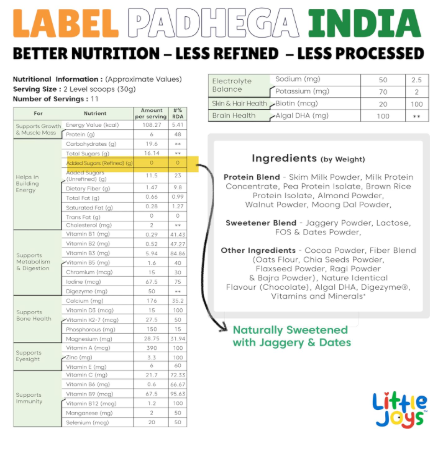
I am referring to Little Joys Nutrimix for healthy growth and daily nutrition (as they claim).
This product became famous in a short period and has commercials on almost every social media platform. Celebrities and even paediatricians are promoting it tirelessly.
So, what is the problem with this product?
After analysing its nutritional information, two main issues stand out: Total sugars and protein. Let me break it down in the aspect of a 2-year-old consuming it daily.
The sugar overload
The total sugar in 2 scoops is 16.14 grams, of which 11.5 grams of sugar is in the added unrefined form, which they say has been obtained from jaggery, dates, lactose, and FOS.
- 16.14 grams of sugar is approximately 4 teaspoons of sugar, which is almost ¾ th of the total sugar intake a 2-year-old could have in a day (25 grams). It remains the same up to 18 years. Most parents give this powder mixed with milk, expecting more benefits. So, along with milk(200ml), there are 27 grams of sugar, which is above a day’s limit.
- Ingestion of this much sugar all of a sudden will cause a sugar spike and an insulin surge.
- There would be behavioural and cognitive changes.
- Physical discomfort, such as abdominal pain.
- It causes a significant metabolic burden for a 2-year-old’s small liver and pancreas.
- Long-term health risks such as insulin resistance, Fatty liver, and Type-2 diabetes.
- While the product uses unrefined sources like jaggery and dates, they are still medically classified as added or free sugars.
- They did not mention the RDA against total sugar, which is questionable.
- Even though marketed as “healthier,” unrefined sugars are still high in calories and primarily composed of sucrose, glucose, and fructose
- Jaggery has a higher glycemic index (85) than sugar (65) despite its health benefits. Since jaggery has been in the good books of Indians, it’s easy to sell something that it is added to.
- Apart from this drink, kids eat breakfast, lunch, dinner, and snacks. Imagine the total sugar consumed in a day! And the snacks are not always healthy options. There are a million products out there loaded with added sugar, and it is almost impossible to avoid them completely in the present scenario. It is a whole other topic to discuss. Then why add some more in the name of healthy food?
The protein misinterpretation
- The daily protein requirement for a 2-year-old is 13 grams, and 1 serving of this product contains 6 grams of protein, which is almost half of the daily requirement.
- Most toddlers easily meet their protein needs through 2 cups of milk and 1-2 small servings of whole foods (like eggs or beans).
- Adding a 6g protein supplement on top of a normal diet potentially strains a toddler’s developing kidneys.
- Long-term consumption of excess protein can cause digestive problems, behavioural changes, dehydration, weight gain, etc.
What can we do?
- Stop using this and similar products that come in labels such as ‘nutrition mix’, ‘protein powder’, ‘health drink’, etc., until and unless your paediatrician has prescribed one for your child.
- Encourage eating balanced meals that contain whole grains, pulses, eggs, fish, dairy, fruits, and vegetables.
- Since these products target the parents of picky eaters, they can incorporate healthy foods in meals by preparing them in different forms and in more palatable ways. I admit it is never easy to feed a picky eater, but substituting it with such drinks should be a strict no.
- Differentiate between your needs and wants. If you come to think of it, spending 600 rupees for something that lasts only 11 days and does no good for your child is not worth it.
- Make a habit of reading labels carefully before purchasing any packaged products, especially when you are buying it for children. Focus total and added sugar, sodium, protein, trans fats and total fat.
- They claim to contain ragi, bajra, almond, moong dal, brown rice, walnut, etc. Yes, it might. But all these ingredients can be found in almost every Indian household. Why not prepare food with it or eat the nuts as such and obtain maximum benefits rather than have it in this form?
As a parent I know that we would do anything to keep our children healthy.
So do the companies marketing such products.
Not only do they broadcast convincing advertisements, but they also use celebrities and paediatricians to promote it.
It’s disheartening to find paediatricians doing this. Instead, they should be advising parents to feed healthy, whole, natural foods.
The health of our children is shaped by the choices we make today. Companies thrive on parental anxiety and convenience, but the truth is simple: Real food beats processed powders every single time.