
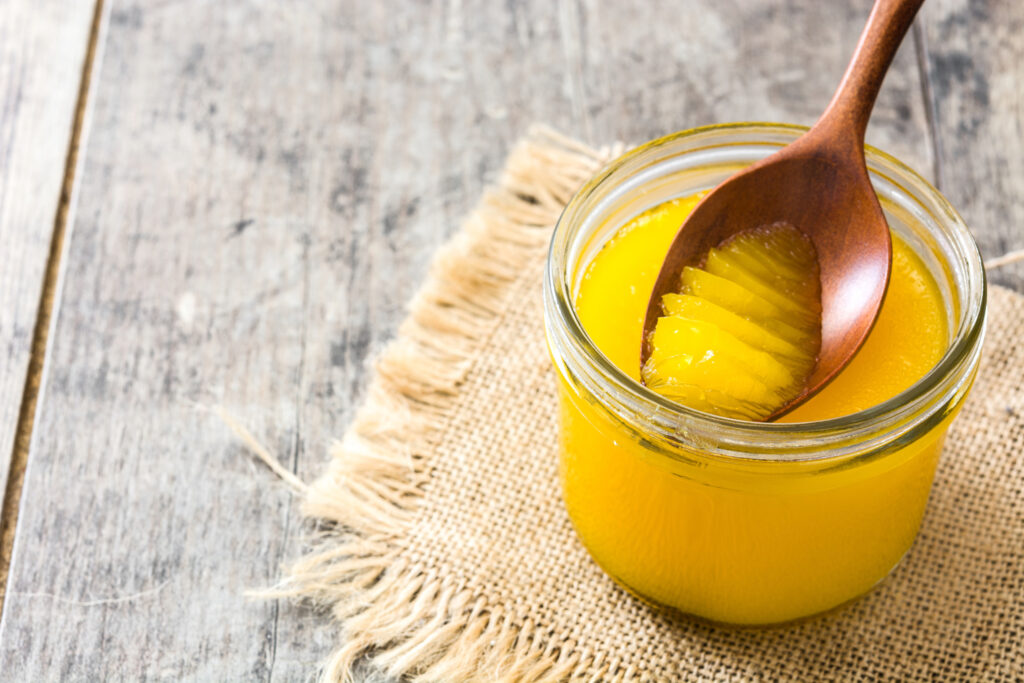
Ghee is clarified liquid fat obtained from milk leaving behind its solid portion. It is widely used in middle east and Indian cuisines since time immemorial.
There are many references regarding ghee in ancient literature. Ghee is considered to have many medicinal properties according to ayurvedic literature.
It was and is used as medicine as such or infused with other medicinal herbs. But many of those claims are yet to be scientifically proven and today there is only experiential proof.
GHEE NUTRITIONAL FACTS:
- It is a saturated fat (60-70 %)
- 1 teaspoon of ghee contains: calories- 42 kcal
Carbohydrates – 0
Protein- 0
Fat – 5 gms
Sugar – 0
Fiber – 0
- It contains omega – 3 fatty acid and CLA ( conjugated linoleic acid)
- It’s a source of vitamins such as Vit. A, C, D, K & E
In ayurvedic literature, ghee is said to have the following properties:
- Imparts intelligence
- Good for memory
- Bestows long life
- Good for fertility
- Good for Poisoning, insanity, skin disease
- Remedy for injuries, burns, fever etc.( ashtanga hridaya sutrasthana)
So there are so many medicinal properties but there are only a few scientific studies done to prove these claims. Some physicians have been able to prove some of these benefits through their experience, but that doesn’t answer the question.
Some believe ghee is harmful for health, especially heart since it is a saturated fat, while some always praise the proven and unproven benefits of ghee and use it on a regular basis.
This has made scientists do some research studies on ghee. Given below are some of them:
COMPARISON BETWEEN THE EFFECT OF COW GHEE AND BUTTER ON MEMORY AND LIPID PROFILE
This study was done on lab rats. The results showed that there was no significant effect on memory in both the groups who were fed with cow ghee and butter.
But there was a reduction in weight to the group fed with ghee and an increase in weight in those who were fed with butter. Both tend to increase in levels of VLDL( very low density lipoprotein) AND TG (triglyceride).
The study concluded that there is no effect on cognition with both and ghee was better than butter .(https://pubmed.ncbi.nlm.nih.gov/27790463/)
THE EFFECT OF GHEE (CLARIFIED BUTTER) ON SERUM LIPID LEVELS AND MICROSOMAL LIPID PEROXIDATION
This study was based on the increased incidence of coronary artery disease in Asian Indians due to high intake of saturated fat ,cholesterol and heated ghee which contains cholesterol oxidation products.
Animal studies have demonstrated many beneficial effects of ghee, including dose-dependent decreases in serum total cholesterol, low density lipoprotein (LDL), very low density lipoprotein (VLDL), and triglycerides; decreased liver total cholesterol, triglycerides, and cholesterol esters; and a lower level of non enzymatic-induced lipid peroxidation in liver homogenate.
A study on a rural population in India revealed a significantly lower prevalence of coronary heart disease in men who consumed higher amounts of ghee and high doses of medicated ghee has seen to decrease serum cholesterol, triglycerides, phospholipids and cholesterol esters. (https://pubmed.ncbi.nlm.nih.gov/22131700/)
EFFECT OF GHEE AND OLIVE OIL IN CARDIOVASCULAR DISEASES
In another study to find out the cardiovascular effect of ghee and olive oil consumption, it was found out that replacing ghee over other fats increased the levels of apolipoprotein-B and non- high density lipoprotein- C compared to olive oil. So this study asks us to replace our dietary fat high SFA (saturated fatty acid) with those having unsaturated fatty acids to reduce the risk of cardiovascular ailments.(https://pubmed.ncbi.nlm.nih.gov/34794522/)
So what is to be understood from all these?
Here are some answers that helps:
- Ghee is not totally bad fat as some might think.
- It contains important vitamins such as VIT. A, D, E , K & C which is essential for any body functions.
- Ghee increases the bioavailability and absorption of some healthy vitamins and minerals.
- Using ghee moderately in one’s diet is appreciated.
- People with genetic predispositions of diabetes, cardiovascular disease etc. should check their ghee intake as it has seen to increase total cholesterol and triglycerides.
- The studies say there are no significant changes in blood lipid levels based on the quantity. Too much consumption of ghee regularly, especially food fried in ghee will lead to heart disease and weight gain ( after all it is a saturated fat)
- Some medicated ghee is showing good results in many diseases but enough scientific study has not been done on it. Use of medicated ghee should be only under the supervision of a registered ayurvedic practitioner.
- Ghee is not a superfood as considered by many ,so don’t replace it with other cooking oils.
What do you think about adding ghee into your diet now? Leave your thoughts, questions and suggestions in the comments section.