
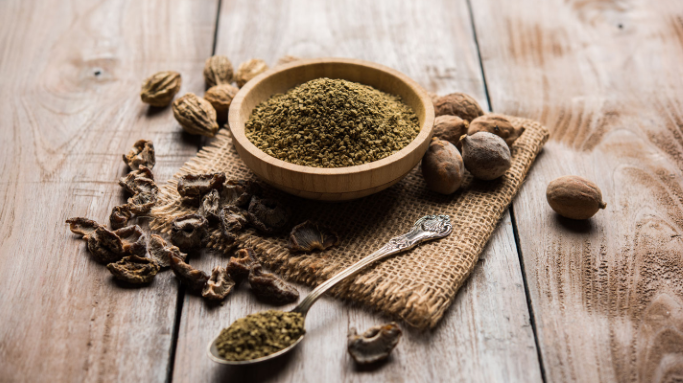
Triphala is a very efficient traditional ayurvedic drug preparation. It is a multipurpose drug that can mitigate and cure diseases affecting different human body systems. It is a well-recognized drug, especially among Indians.
‘Triphala’ is a Sanskrit word for ‘three fruits’ (tri- three Phala- fruit) which are Amalaki( Indian gooseberry), Haritaki( chebulic myrobalan), and Bibhitaki (Beleric myrobalan). All these three fruits are cut and dried in sunlight. Then it is powdered to get Triphala churna. This is the most commonly used preparation. At the same time, there are also other kinds of preparations like Arishta(fermented decoction), Kashaya (decoction), and Guggulu (resin ). The references to Triphala are available in ayurvedic literature by various authors. The most commonly referred one is in Astanga Hrduyam.
Let me walk you through the properties and benefits of individual drugs used in Triphala
Amalaki (Indian gooseberry)
BOTANICAL NAME: EMBILLICA OFFICINALIS)
LOCAL NAMES: AMLA, NELLIKKAI, NELLIKKA, AMMALAKI etc.
Indian Gooseberry is a member of the family Phyllanthaceae which grows in India, the middle east, and some southeast Asian countries. It is widely used in India as medicine and food.
Gooseberries, fat, and carbohydrates are very low in calories ( a cup- 66kcal). They contain abundant Vitamin C (a cup- 46% of DV). It also contains a considerable amount of vitamin B6, vitamin B5, Copper, and Manganese. Vitamin C is a powerful antioxidant and as many of you know antioxidants reduce the risk of many diseases. They protect the cell from damage that occurs due to the action of free radicals produced in the human body. Various experiments on the action of antioxidants continue to be studied.
Gooseberry is also an immune protectant and it is good for hair, skin, and the nervous system due to the presence of antioxidants. Studies show that the antioxidants in gooseberry keep the heart healthy and help it function properly. Many research studies have been done on the anti-carcinogenic properties of antioxidants. Some animal studies have already shown positive results.
Indian gooseberry also contains phenolic compounds, tannins, phyllembic acid, phyllembelin, curcuminoids, gallic acid, flavonoids, pectin, etc. The fiber content of this fruit is also remarkable which makes it gut-friendly. The citric acid present in gooseberry may fight age-related brain diseases.
According to Ayurveda, the following are the benefits of gooseberry
- Easily digestible
- Kindles hunger
- Helps in digestion
- Improves intelligence
- Maintains youth
- A good laxative
- Bestows long life
- Strengthens sense organs
- Cures many skin disease
- Good for chronic fever
- Good for anemia
- Prevents heart disease
- Good for cough and anorexia etc
Most of these properties have been scientifically proven and it has been widely used as medicine for ages.
haritaki (INDIAN WALNUT/INDIAN HOG PLUM)
BOTANICAL NAME: TERMINALIA CHEBULA
LOCAL NAMES: HARAD, KADUKKAI, KADUKKA, KARAKKAYA
Haritaki (chebulic myrobalan) is a member of the Combretaceae family. It is found mainly in Southeast Asia, especially in India, southwest China, Srilanka, Malaysia, Vietnam, etc.
Haritaki is a good source of vitamin C and it contains the minerals such as Magnesium, Potassium, Iron, Selenium, Copper, etc. They also contain tannic acid, stearic acid, palmitic acid, and chebulic acids and it is a source of several flavonoids and antioxidants. Haritaki is being used widely as medicine by Indians and Tibetans. There are 7 varieties of haritaki according to Ayurveda and according to botanical sources, there are 6 varieties.
Many studies were conducted on haritaki regarding its pharmacological activities such as anti-diabetic, anti-inflammatory, cytotoxic, hepato-protective, and neuroprotective.
According to Ayurveda, the properties remain the same for Haritaki and Amalaki. The only difference is that it reduces the doshas Kapha and Vata and is of hot potency. It is also mentioned that one should use haritaki carefully because of its hot potency. It is better to avoid during pregnancy, dehydration, etc.
vibhitaki/bibhitaki (beleric myrobalan)
BOTANICAL NAME: TERMINALIA BELLIRICA
LOCAL NAMES: BAHEDA, BAHERA, BEHADA, THANNIKKA,VADIKKAYA,TAREKAPI
Bibhitaki belongs to the Combretaceae family and is widely distributed in plains and lower hills of the south and southeast Asia.
Bibhitaki fruit is high in tannin content and contains a good amount of fiber. It also contains minerals like calcium, phosphorus, selenium, manganese, copper, iron, etc. Other chemical components present in bibhitaki are gallic acid, ellagic acid, cardiac glycosides, chebugalic acid, galactose, mannitol, etc.
In Ayurveda, Bibhitaki is considered to be of cold potency as Amalaki and it is good for hair. The properties of bibhitaki are similar to that of Amalaki and haritaki.
Various studies have been conducted on the antioxidant, antidiabetic, anti-inflammatory, and anti-cancerous activity of Bibhitaki.
So these were the individual properties of the drugs in Triphala. When combined together they help in managing many day-to-day health issues.
benefits & uses of TRIPHALA churna
Triphala churna is prepared by powdering equal parts of dried Amalaki, Bibhitaki, and Haritaki. It is one of the most commonly prescribed drugs by ayurvedic physicians because of its broad-spectrum action.
The properties of Triphala churna are:
- Antiseptic
- Antioxidant
- Anti pruritic
- Hypoglycemic
- Laxative
- Anti-microbial
- Prokinetic
- Rejuvenative
- Clarifying
- Healing
- Purifies blood
- Immunomodulating
- Preventive etc.
According to Ayurvedic literature, Triphala is indicated in various diseases and conditions. They are:
- Skin diseases
- Obesity
- Diseases of eyes
- Diabetes mellitus
- Hyperlipidemia
- Inflammation
- Diseases of blood
- Constipation
- Fever
- Ulcers/ wounds
- Gastric acidity/ peptic ulcers
- Piles, Fistula, etc.
Triphala can also be used as a preventive medicine to keep eyes healthy and to prevent conditions like obesity, hyperlipidemia, constipation, etc.
Triphala churna can be administered both internally and externally. The water boiled and cooled by adding Triphala is used as eye drops, for eye wash, washing wounds /ulcers in specific quantities and concentrations. Its thick paste is used as an anointment and the powder is used for body massage (Udwartana).
Even though Triphala should be prescribed for all these diseases or conditions, it can be taken as a supplementary drug as well. That can keep your eyes healthy, and your gut clear, keep a check on your glucose and cholesterol levels and boost your immunity.
How to use Triphala churna?
- Constipation: 1-2 teaspoons in 250 ml of lukewarm water/lukewarm milk at bedtime.
- Pre-diabetic/risk of diabetes: 1 teaspoon in 250 ml lukewarm water at bedtime.
- For healthy eyes: 1 tsp powder mixed with ghee & honey ( 1 part ghee & 2 parts honey) at bedtime.
- For an itchy scalp: apply the paste of churna mixed with water OR wash with water boiled with Triphala churna.
- For mild mouth ulcers: gargle the water boiled with Triphala churna intermittently.
- As a general health tonic: 1 tsp powder mixed in 1 tsp of honey or ghee OR 1 glass of lukewarm milk/water after dinner.
It is a safe medicine and one can always keep it in their first aid medicine kit for any bowel problems, itching, minor insect bites, minor infections, etc.
Takeaway
Several scientific research and experiments were done and continue to be done on Triphala owing to its amazing benefits in a broad spectrum of diseases. It is used in many ways according to the condition of the patient and disease as Rasayana, Churna, Kashaya, or Arishta, but the property of the drug is never compromised. Researchers have found the potential effectiveness of the drug for several clinical uses such as anti-microbial, anti-fungal, appetite stimulation, anti-mutagenic, hypoglycemic, reduction of hyperacidity, chemoprotective and radioprotective effects. Also, studies done in rats have shown that Triphala churna mitigates diabetic neuropathy.
Triphala is a very promising drug formulation and it has already proven its effectiveness through the experience of many users including me and my patients. It is a must-have drug in your home medicine kit.